
Gestalt therapy belongs to the group of humanistic psychotherapies, and yet it is more than that. It is an attitude towards life: trust in the organism’s self-regulation and self-organisation; change through complete acceptance of what is, more than just understanding it intellectually.
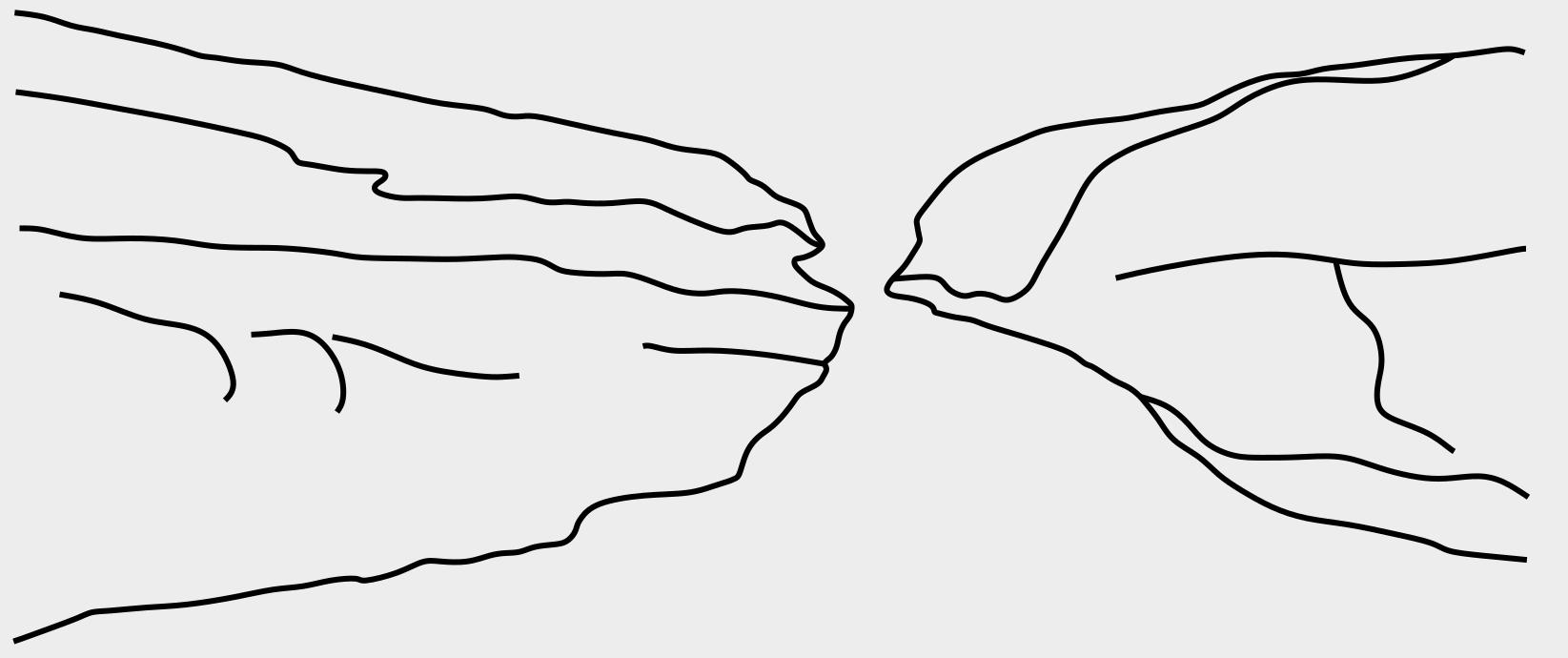
In the middle of the 20th century, Laura and Fritz Perls, Paul Goodman and others developed the foundations of today’s Gestalt therapy. It was a radical change from the previously recognised classical psychoanalysis. Attention was focused on the momentary experience, the therapeutic authority of interpretation was replaced by non-directive work, the ability to perceive was trained, and the therapeutic relationship was placed at the heart of therapy.
What does Gestalt mean?
In Gestalt psychology the German word Gestalt was taken to mean a meaningful whole, a figure that is distinct from a background. Think of it as the melody that stands out from the accompaniment, or as hunger, which is clearly and urgently in the foreground despite all other sensations. The same applies to feelings, past experiences that reoccur as memories, and fears for the future, etc.
In Gestalt therapy, a Gestalt is the feelings, memories etc. that are in the foreground, emphasised and present at any moment. The current Gestalt reflects the most important need in the context of the moment. Once this has been satisfied, the next most important need appears as the new contextual Gestalt. The Gestalt formation process thus has a natural succession.
However, the concept of what a Gestalt is should not be understood simply as an intellectual concept, or a single perception. It is what arises through perceiving and giving meaning to the sensations from the five senses.
Working in the Here and Now – And What About My Past?
Gestalt therapy works by bringing attention to the current Gestalt. Whatever you are currently occupied with serves as the starting point for the therapy session. Naturally, the past and future influence the present. But where does life take place? Painful or beautiful memories, anticipation, planning, or a fear for the future are experienced at this moment. The present Gestalt may be of the past or the future, in terms of content, but is always rooted in the present.
Therapeutic counselling serves as a support, helping not to just avoid the difficult feelings or states, but to stay with them, as in the here-and-now is it possible to act and thus exists the chance to give your life a chosen direction.
The Focus of the Process – Rather How Than What
In the therapeutic process there are two specific levels; the content of what is going on and the way this is conducted. What happened in the past, what is happening right now, what will happen in the future, and so on are contents of experience, or life story. They are usually linked to thought, and thus distract from what is present momentarily. The way of conduct is how a person speaks, how they gesture, how they use facial expressions, etc. leading to the bodily expressions, and corresponding sensations presented in this moment.
Both levels have their place within the therapy. New insights and paths for the ‘what’ can arise through the present-orientation of the ‘how’. This is why Gestalt therapy focuses more on the ‘how’ than the ‘what’.
The Therapeutic Relationship – Meeting As Equals
Contact occurs when living beings meet and acknowledge each other. In all relationships, recognising, sensing and negotiating this contact is necessary repeatedly. To be more precise, for a nourishing contact or relationship we need to refine and adjust our interaction again and again. In doing so, authentic encounters are possible that surpass familiar phrases.
The therapeutic relationship is special in that it occurs outside of everyday life. It is a relationship based on equality, respect and trust. It requires dedication, effort, and honesty on the part of all parties. In this relationship, risks can be taken, so that new experiences can be made; e.g. to discuss the otherwise non-discussible.
All real living is meeting.
Martin Buber
Change – a Paradox
In my opinion change requires intention and acceptance. On the one hand, there must be your intention to want to change something. Without this, deep introspection is rarely possible. On the other hand, change can only happen if, first, there is acceptance of what is.
Superficially, altering behaviours for a short-term relief works quite well; typically the problem reoccurs with somewhat different characteristics. By real change I mean a fundamentally new perspective or orientation that arises from the experience of one’s own aliveness, rather than from concepts or demands that come from outside. By accepting what is, and the desperation, or insolubility of the situation, can a real change occur.
Change occurs when someone becomes what one is, not when one tries to become what one is not.
Arnold Beisser
Possible Adverse Effects
As with other treatments, psychotherapy can also have unintended and adverse effects. Examples are: Your psychological symptoms may initially worsen, or tensions with people in your environment may increase; you may feel overwhelmed and want to stop treatment; however, you may also feel that you can no longer cope without therapy. Overall, the side effects of psychotherapy have been little studied to date.
The above may be part of a normal therapeutic process. If you experience any of this, please bring it up during the sessions.
You can end therapy or change therapists at any time. I respect your decision and ask that you speak to me in this case.